A Guide to Selecting Bowls
Whilst this guide is aimed at new bowlers buying their first bowls, it may also be helpful to anyone looking for a replacement or additional set.
Where a heavy or slow green is referred to this means a green on which bowls do not run quite so freely. This will generally be due to the surface being wet and/or soft, or the grass being that bit longer. On a green in this condition it can take a lot more effort to send a bowl long distances.
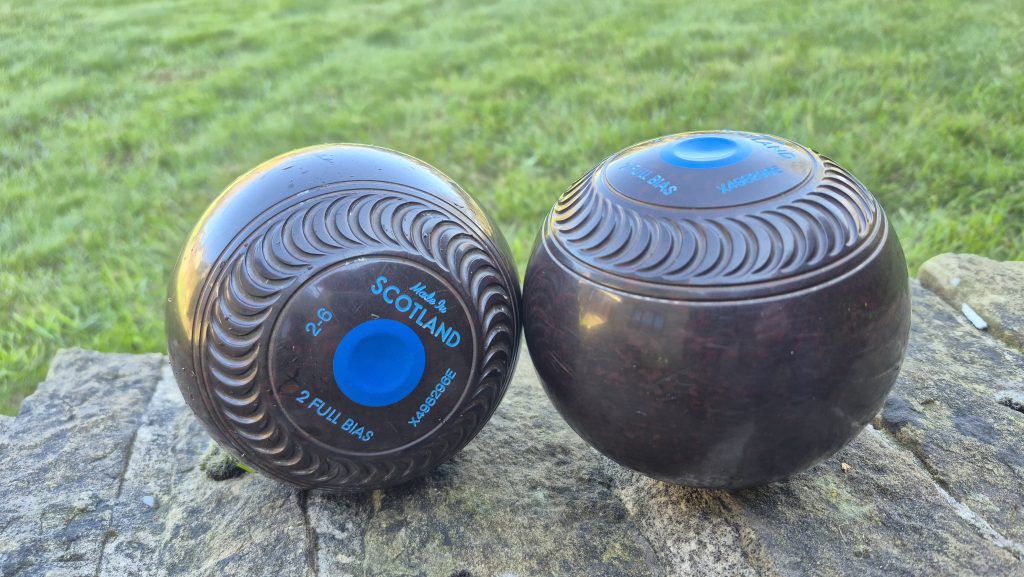
A word of warning for new bowlers. Make sure you have your hands on crown green bowls. As obvious as this sounds it is very easy, especially with used bowls or family bowls that have been handed down, to make the mistake of picking up flat green bowls. As the name suggests, these are for a flat playing surface, which a crown green most certainly is not. Even to an experienced eye these can be difficult to tell apart. All crown green bowls and jacks have the same bias, known as a 2 FULL BIAS to enable them to handle the contours of the green. The bias dictates the natural arc that a bowl will curve in. There is much less bias, so less turn, in flat green bowls and trying to use these effectively on a crown green would be very difficult. If in doubt ask for help at your club.
Where to begin?
Standard or high density? Light or heavy? Smooth finish or textured grip? With so many options—and a range of manufacturers to match—it’s no wonder choosing a set of bowls can feel a bit overwhelming.
The advice most people hear is simple enough: “Try a few and see what feels right.” That’s not bad guidance, but it does raise a fair question—what exactly does “right” feel like?
Then there’s the received wisdom around weight and density. You might hear that low-density bowls “run on” further and suit slower greens, while high-density bowls “pull up” sooner and are better for faster surfaces. Standard density, meanwhile, is often described as a safe all-round choice. Add to that suggestions that heavier bowls ‘reach’ further (they don’t) than lighter ones, and it all becomes rather confusing.
The trouble is, much of this advice—though well intentioned—doesn’t quite hold up. So let’s take a closer look at what’s really going on.
Myth buster 1: “Heavier is better – use the heaviest bowls you can ”
This is a common piece of advice—but it’s not quite right. So why would a heavier bowl be better? It cannot be moved so far when hit by someone else’s bowl, is one argument. But on the flip side, being bigger, it is a bigger target to hit. It can be blown less off course by strong winds is another. But, being larger, it catches the wind more. The truth is heavier bowls bring both advantages and disadvantages, however the disadvantages can quickly start to outweigh any advantages – as we’ll see below.
When it comes to weight the thing that matters most is that weight plays a decisive role in how far you can deliver a bowl. Put simply, you can send a lighter bowl further than a heavier bowl for the same amount of effort. This is just basic physics.
Imagine a player, using all their strength, sending a 2lb 8oz bowl a maximum distance 40 metres. Swap that for a 2lb 4oz bowl—around 10% lighter—and, with the same effort, it will leave the hand faster and travel further. On a 40-metre delivery, even a 1% increase in release speed can be worth somewhere between half a metre and a metre of extra distance, depending on how fast or slow the green is running.
You can see this when setting a jack (weighing 1lb 7oz). Most players can easily send the jack a full corner to corner distance and beyond – without much trouble and regardless of whether a green is heavy. But they cannot easily achieve the same distance with their much heavier bowl, if at all. It is much more of a challenge. You do not need any more proof, than what you can do with a jack, to see that lighter woods can be sent greater distances for less effort.
So, by all means err towards a heavier bowl but be sure it does not limit how far you can deliver it on a heavy/slow green, or worse still on a green that isn’t running slow.
Myth buster 2: “Heavier bowls ‘run on’, so go further”
It can certainly look that way. A heavier bowl often seems to keep going at the end of its run, creeping forward and taking much longer to come to a stop.
But appearances are deceptive. Heavier bowls may appear to “creep on” due to being larger. At the same forward speed, a larger bowl rotates more slowly than a smaller one. As a bowl approaches the end of its journey and slows to a crawl, this can make the heavier bowl appear to be moving very slowly while somehow continuing to go. The effect is most noticeable over the final few feet, but it does not mean the heavy bowl has greater reach. It may simply be the way our eyes interpret a large, slowly rotating object. While that heavier larger bowl appears to take longer to slow at the end of it’s journey it is the lighter smaller bowl that, for the same amount of effort, will have made the longer journey.
This illusion of “creeping on” is also observed with “marbled” bowls where the colour pattern makes their rotation much more visible than a plain black or brown bowl.
Myth buster 3: “Density affects how far a bowl runs”
If you compare bowls of the same weight, density makes no meaningful difference to how far they travel. A 2lb 8oz bowl will behave much the same whether it’s low, standard, or high density. The main difference is size.
Where density does matter is when you’re thinking about what size of bowl fits your hand best. Bowls of the same size come in different weights depending on their density. That means you can find a bowl that fits your hand well to give a secure grip (See Myth buster 4), then choose a density that gives you the optimum weight. (See Myth buster 1). It’s a useful way to fine-tune your choice—getting both comfort and performance.
Myth buster 4: “If you can hold it upside down without dropping, it fits”
That’s a start—but it’s not the full picture.
In real world conditions—cold, wet, or having to send long distances on heavy greens — you’ll need a much more secure grip than that. The key factor here is size, not weight. And a secure grip is critical to retaining accuracy when you are bowling, especially when bowling longer distances.
A well-fitting bowl should feel comfortable and secure in all conditions. Shape and grip patterns can also help, these vary from make to make. In general, though, it’s often better to err slightly on the smaller side than go too large.
So, where does this leave us?
If you’re trying to choose the right bowls, a few simple steps can help:
- Start with size – compare different sizes, make sure you can hold the bowl comfortably and securely in all conditions.
- Find the right weight – choose a weight you can deliver to the longest distances.
- Use density to fine-tune – pick the density that gives you the best weight for your preferred size.
- When in doubt, go a little lighter and/or smaller.
- Try before you buy – use your club’s bowls or try someone else’s before you buy.
Choosing bowls doesn’t have to be complicated. With a bit of understanding—and a bit of trial and error—you can find a set that suits you.